
A client sends over three employee address changes at 4:47 on a Friday. Then a termination notice Monday morning, with an ROE needed “as soon as possible.” By Wednesday they want a custom report breaking out overtime by department, something that was never discussed when the engagement started. None of these requests are outrageous on their own. But multiply that pattern across twenty or thirty payroll clients and you’re looking at a team buried in work that nobody agreed to, nobody tracked, and nobody billed for.
That’s payroll scope creep, and it’s one of the quietest margin killers in Canadian accounting firms.
By the end of this piece you’ll understand the mechanism that produces scope creep, why it persists even in well-run firms, and how to build a practical boundary framework so your team can recognize out-of-scope work before it becomes an operating assumption.
Who should keep reading (and who shouldn’t)
This applies to you if you’re a Canadian accounting, bookkeeping, or CPA firm processing payroll for multiple clients, especially if you’re running fixed-fee engagements and noticing that actual hours consistently exceed your estimates. If you manage fewer than five payroll clients and bill purely by the hour with granular time entries, scope creep is less likely to be invisible to you. You probably already see it on every invoice.
If you’re looking for a step-by-step payroll processing guide or CRA remittance instructions, the Government of Canada’s payroll obligations page is a better starting point.
What payroll scope creep actually is
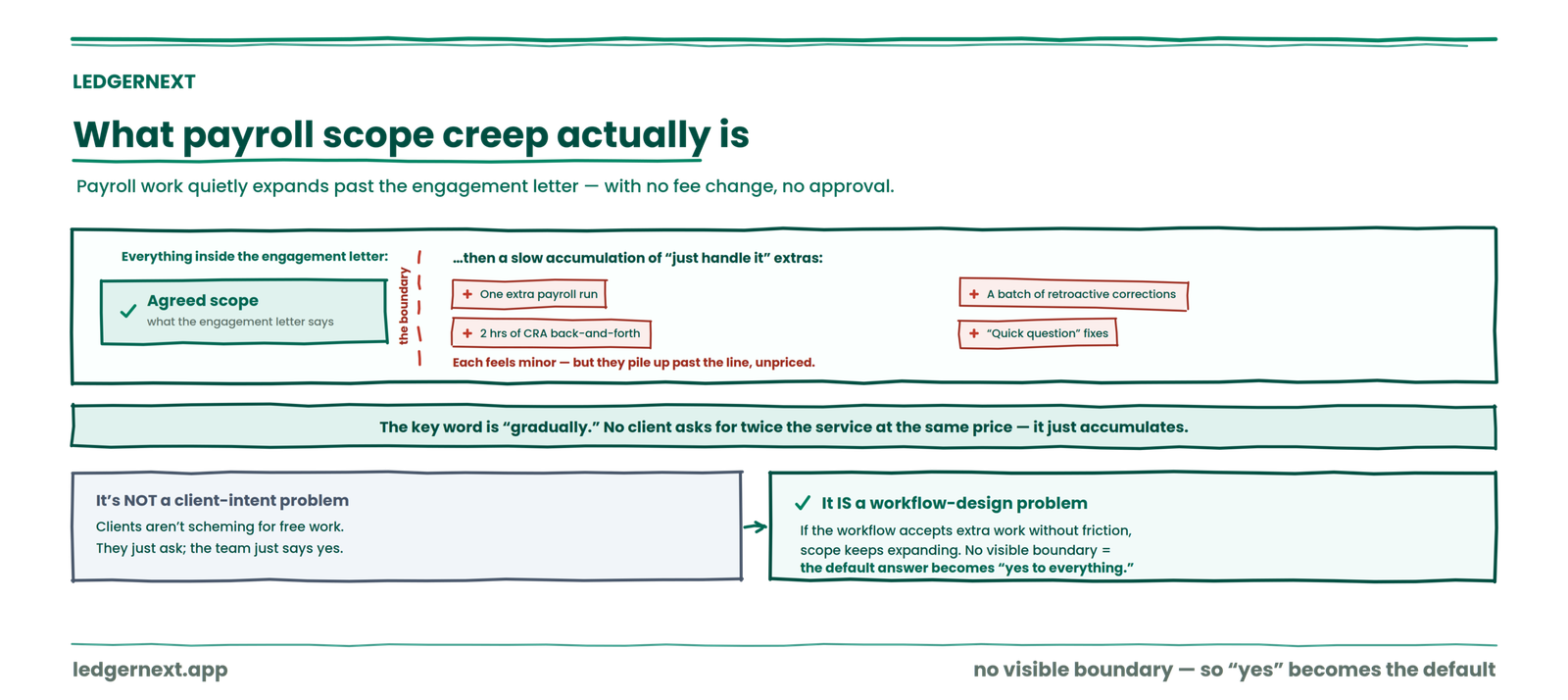
Payroll scope creep occurs when a firm’s payroll responsibilities gradually expand beyond the services originally included in the client engagement letter, typically without a corresponding change in fee or formal approval.
The key word is “gradually.” Almost no client sits down and deliberately asks for twice the service at the same price. What happens instead is a slow accumulation. One extra payroll run here. A batch of retroactive corrections there. CRA correspondence that requires two hours of back-and-forth. Each individual request feels minor enough that the team just handles it.
The mechanism underneath is simple: if the firm’s workflow accepts additional work without friction, the scope will keep expanding. This isn’t a client-intent problem. It’s a workflow-design problem. When there’s no visible boundary between included and excluded work, the default answer becomes “yes” to everything.
Why payroll scope creep is a growing problem for accounting firms
Scope creep isn’t just an annoyance. Left unchecked, it does measurable damage to how a firm runs and how it grows. Five effects compound as the client base scales.
It reduces payroll profitability
Fixed-fee payroll is priced on an expected amount of work. Every unbilled extra run, correction, or “quick question” is effort delivered at a fee that never accounted for it. Across a client base, that quietly erodes realization rates on the exact service line firms assume is stable and predictable.
It creates unpredictable workloads
When out-of-scope requests arrive without a boundary, the team can’t forecast its own capacity. A cycle that should take a known number of hours balloons because of last-minute changes and off-cycle demands, making it hard to plan staffing or commit to turnaround times.
It leads to unclear client expectations
When the firm absorbs extras without comment, clients reasonably assume those extras were always included. The boundary erodes on both sides: the team stops distinguishing included from extra, and the client stops expecting to be charged for it. Resetting that expectation later is far harder than setting it clearly up front.
It makes payroll harder to scale
A process that depends on the team quietly absorbing exceptions doesn’t scale cleanly. Adding more payroll clients multiplies the invisible work rather than the billable work, so growth in client count doesn’t translate into proportional growth in margin.
It can increase the risk of errors
Rushed, undocumented, out-of-cycle work is where mistakes happen. When the team is in chase-and-fix mode on late changes and emergency runs rather than running a standardized process, the odds of a payroll or compliance error rise, and errors in payroll carry real consequences.
Why the engagement letter alone doesn’t fix it
Most guidance on scope creep starts and ends with “write a better engagement letter.” Canadian CPA guidance does recommend documenting revised scope and fee impact when work exceeds the original agreement. That’s sound advice. But here’s where practice diverges from the published version.
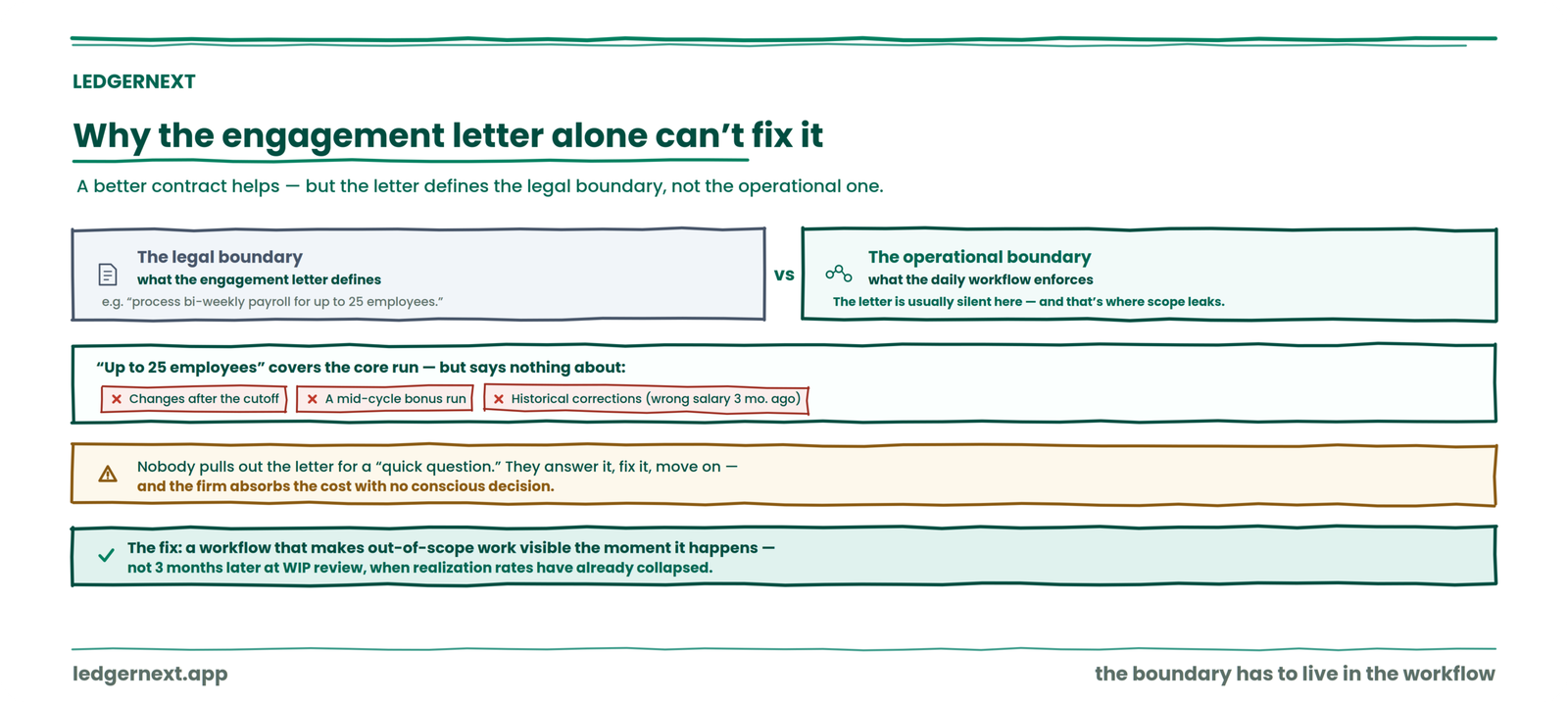
Engagement letters define the legal boundary. They rarely define the operational boundary.
A typical engagement letter might say the firm will “process bi-weekly payroll for up to 25 employees.” That covers the core run. It says nothing about what happens when the client submits changes after the cutoff, requests a mid-cycle bonus run, or needs historical corrections because they gave you the wrong salary for someone three months ago.
Staff on the ground don’t pull out the engagement letter when a client emails a “quick question.” They answer it. They fix the thing. They move on. And the firm absorbs the cost without anyone making a conscious decision to do so.
So the real challenge isn’t writing better contracts (though that matters). It’s building a workflow where out-of-scope work becomes visible the moment it happens, not three months later when a partner reviews WIP aging and wonders why realization rates collapsed on half the payroll clients.
The seven places scope leaks
What’s included in payroll depends entirely on your service agreement and pricing model. There’s no universal standard. But these are the categories where scope most commonly expands without anyone noticing:
| Request type | Typically included? | Where it becomes extra work |
|---|---|---|
| Scheduled payroll runs | Yes | Additional runs beyond the agreed frequency |
| Employee data changes | Often yes, in small volumes | Repeated last-minute changes or bulk updates |
| Off-cycle payments | Usually separate | Emergency or bonus runs with no lead time |
| Historical corrections | Usually separate | Errors requiring investigation across prior periods |
| CRA correspondence | Depends | Complex notices requiring substantial research |
| Custom reporting | Depends | Reports not defined in the original scope |
| Year-end T4 corrections | Often separate | Rework caused by late or inaccurate client data |
The biggest losses usually aren’t the dramatic add-ons. They’re dozens of tiny follow-up clarifications, quick questions, and small fixes that individually take ten minutes but collectively reach 80 hours across your client base in a quarter, with none of it billed.
Warning signs your firm already has this problem
You don’t need a forensic audit to spot scope creep. You need to ask your team four questions.
Can each person on your payroll team explain, in under 30 seconds, what’s included for a specific client versus what’s extra? If they hesitate, the scope boundary is too vague.
Are actual hours consistently exceeding estimated hours on recurring payroll jobs? Accounting workflow vendors flag this as the clearest warning sign of scope drift.
Do clients routinely submit information after your internal cutoff? Late data is one of the most common triggers because it shifts the team from production mode into chase-and-fix mode, which is slower, more error-prone, and almost never tracked separately.
When someone on the team handles an ad hoc request, is there any record of it? If the answer is “not really,” you have no task-level evidence to support a fee conversation, even if you know the scope has expanded.
Quick self-assessment
If you checked fewer than four of those, scope creep is probably already affecting your margins.
What actually stops scope creep
The scope boundary has to live in the workflow, not just the contract
Your engagement letter should define payroll frequency, employee volume assumptions, submission deadlines, standard reports, year-end responsibilities, and what constitutes a change order. CPA Canada’s guidance is clear that expanded work warrants documented scope and fee revisions. But that document only works if the daily workflow enforces it.
That means your team needs a visible, repeatable process for flagging exceptions in real time. Not a policy memo. A workflow step.
Track extra work at the task level
This is where most firms fail. They sense the scope is leaking but lack the granular data to prove it. Time tracking by client isn’t enough. You need time by task: payroll processing, corrections, ad hoc support, CRA follow-up, client communication. Without that separation, you can’t distinguish a profitable payroll client from one that’s quietly consuming twice the expected hours.
One approach that works well in practice: set a capped allowance for ad hoc support hours per client. Once the threshold is crossed, the overage triggers a scope review. Not a confrontation. Just a data-backed conversation.
Freeze the cutoff and enforce it
Late changes, missing approvals, and undocumented special cases are the single biggest driver of payroll taking longer every cycle. The community fix that consistently works is a hard cutoff date with all exceptions bundled into one change request, submitted through a written process. If it arrives after the cutoff, it goes into the next cycle or triggers a fee-approved change order.
This feels uncomfortable the first time. Clients push back. But firms that enforce it consistently report that within two cycles, clients adapt, and the team stops spending hours chasing fragmented updates.
Make out-of-scope work visible immediately
Scope creep compounds when exceptions are invisible until month-end. If a team member spends an unplanned hour on a CRA notice for a payroll client, that should be captured the same day, not reconstructed from memory during a billing review. The goal isn’t to bill for every minute. It’s to make the pattern visible so you can reprice the engagement or redesign the workflow before the problem grows.
Make out-of-scope work visible the moment it happens
LedgerNext runs payroll and bookkeeping through one connected workflow, so exceptions surface automatically instead of hiding in email threads until month-end.
The Included, Exception, Extra framework
We developed this framework at LedgerNext to give firms a simple decision filter for incoming payroll requests. It’s not an industry standard. It’s a practical tool.
Every payroll request falls into one of three categories:
Included
The work is part of the standard service agreement. Regular scheduled payroll runs, standard reports, routine employee changes within normal volume.
Exception
The request is unusual and requires review, but doesn’t automatically trigger additional billing. A mid-cycle termination might be handled within scope, or might not. The point is someone consciously decides rather than the team absorbing it by default.
Extra
The work is clearly outside the agreed scope and requires separate approval or billing before it starts. Emergency off-cycle runs, historical corrections spanning multiple periods, custom reporting that was never discussed.
| Category | What it means | Example |
|---|---|---|
| Included | Covered by the service agreement | Scheduled bi-weekly payroll |
| Exception | Requires conscious review | Mid-cycle termination with ROE |
| Extra | Outside scope, needs approval first | Retroactive corrections for three prior quarters |
The value isn’t in the categories themselves. It’s in forcing a decision point. When every request has to be classified before work begins, the team stops defaulting to “just do it” and the firm starts accumulating the data it needs to reprice engagements accurately.
Where practitioners disagree
There’s a live debate about whether firms should bill ad hoc payroll support by the hour or absorb a reasonable amount within a fixed fee. Some practitioners argue that billing every ten-minute question damages the client relationship and creates friction that costs more in goodwill than it recovers in revenue. Others point to data showing that unbilled ad hoc support is the single largest category of scope leakage, and that a capped allowance with overage billing is the only model that scales. I land on the capped-allowance side, because without a threshold, “reasonable” ad hoc support expands until it isn’t reasonable anymore, and by then you have no data to support the repricing conversation.
The problems nobody talks about
| Problem | Root cause | What actually fixes it |
|---|---|---|
| Payroll takes longer every cycle | Late changes and undocumented exceptions | Hard cutoff date with bundled change requests |
| “Quick questions” consume hours weekly | Ad hoc support not defined in the engagement | Capped support allowance with overage tracking |
| Fee increases get rejected by clients | Client only sees price, not workload growth | Show a before-and-after task breakdown from time data |
| Team does extra work without flagging it | No operational boundary in the workflow | Route every add-on through a written scope step before work starts |
ADP Canada’s payroll guidance notes that standardizing records like T4s, ROEs, and CPP contributions through automation reduces errors and processing time. That’s true for the production work. But automation doesn’t fix the boundary problem. If your automated system processes an extra payroll run because a client asked nicely, you’ve just automated the scope creep.
What should be included in a payroll service agreement?
A service agreement can’t cover every future request, but it can define the boundary clearly enough that the team knows when something crosses it. If you’re tightening yours, make sure it explicitly addresses each of these areas:
The point isn’t to draft an exhaustive contract. It’s to make sure that when a request doesn’t fit these definitions, everyone can see it doesn’t fit, and the change-order process kicks in instead of the work quietly getting absorbed.
How technology can help prevent payroll scope creep
Scope creep is fundamentally a visibility problem: extra work is invisible until it’s already been done. Technology doesn’t set your boundaries for you, but the right system makes crossing them impossible to miss. In practice, that means using tools to centralize client information, standardize the payroll workflow, make exceptions easier to identify, reduce repeated manual work, improve visibility across multiple clients, and keep payroll and bookkeeping information connected rather than scattered across separate systems.
For firms managing payroll alongside bookkeeping, having connected client information and standardized workflows can make it far easier to see where exceptions and extra work are actually happening. When both run through one system, the boundary between included and extra work stops depending on memory and starts being a visible step in the process.
Connected client information
Running payroll and bookkeeping and reconciliation through one platform keeps a client’s full picture in one place, instead of split across email, spreadsheets, and separate tools.
Standardized workflows
A repeatable, standardized workflow gives every payroll job the same steps, so an out-of-scope request has to pass through a review point rather than slipping straight into production.
Exceptions surface automatically
When the workflow flags anything outside the standard path, the pattern of extra work becomes visible in real time, giving you the evidence base a repricing conversation needs.
LedgerNext is built for exactly this: connecting payroll and bookkeeping in one workflow so Canadian firms can see scope drift as it happens, not months later. It doesn’t replace the boundary decisions, which stay with the firm, but it makes those decisions visible and consistent across every client.
What this means for your next step
Scope-management improvements usually compound after the firm completes at least one full cycle of tracked jobs and renewal conversations. The first round gives you baseline data. The second round gives you comparison data. That’s when repricing conversations stop being awkward and start being evidence-based.
If your firm is managing payroll for multiple clients alongside bookkeeping, the fastest way to make scope visible is to get both workflows running through a shared system where exceptions surface automatically instead of hiding in email threads.
Frequently asked questions
What is payroll scope creep?
Payroll scope creep is when a firm’s payroll responsibilities gradually expand beyond the services originally included in the client engagement letter, usually without a matching change in fee or formal approval. It happens through the slow accumulation of small extras, an off-cycle run here, a correction there, that individually feel minor but collectively become significant unpaid work across a client base.
What causes payroll scope creep in accounting firms?
Payroll scope creep in Canadian accounting firms typically starts with unclear service boundaries in the engagement letter, combined with workflows that accept additional client requests without a formal review step. Late submissions, vague definitions of included work, and no task-level time tracking allow extra work to accumulate invisibly across the client base.
How can accounting firms make payroll services more profitable?
Start by making extra work visible: track time by task, not just by client, so you can see which engagements consume more than the fee assumes. Then define a clear boundary between included and out-of-scope work, enforce a submission cutoff, and route add-ons through a change-order step. Reviewing payroll profitability quarterly and tying findings to renewals is what turns that visibility into recovered margin.
How do I know if a client is out of scope?
Compare the specific request against the engagement letter and the task list your team actually performs. If your staff can’t make that comparison in 30 seconds, the scope definition is too vague to be operationally useful.
Should firms charge separately for every extra payroll request?
It depends on your pricing model and client relationship. A capped allowance for ad hoc support, with documented overage billing, tends to balance client satisfaction with margin protection better than either extreme. The critical thing is identifying and tracking extra work so you can make an informed decision rather than absorbing it by default.
How can software help manage multiple payroll clients?
Software helps most by centralizing client information and standardizing the workflow so the same steps run for every client and every cycle. That makes exceptions easier to spot, reduces repeated manual work, and improves visibility across the whole client base. When payroll and bookkeeping share one system, out-of-scope work surfaces automatically instead of hiding in scattered email threads.
Why is payroll still taking so long even after adding automation?
Because automation removes repetitive production steps, but it doesn’t fix bad source data, late client submissions, or undefined scope boundaries. If the inputs are messy or the requests keep expanding, your team still spends manual hours on exceptions and follow-up. Separating production work from cleanup work in your client onboarding processes makes the bottleneck visible.
How long before scope controls actually improve margins?
Expect process clarity almost immediately, but meaningful fee recovery usually takes more than one billing cycle. You need at least one full round of tracked data before you can show clients the gap between agreed scope and actual work. Firms that review payroll profitability quarterly and tie findings to engagement renewals see compounding improvement, but the first cycle is about building the evidence base, not recovering lost revenue.
The next problem most firms hit after fixing scope boundaries is standardized workflows across the rest of their client work. Payroll is usually where the pain is sharpest, but the same pattern of invisible extra work tends to exist in bookkeeping and reconciliation too. Start where the data is worst, fix the boundary, then expand the model.
Stop letting small payroll requests become unpaid work
Scope creep rarely begins with one large request. It usually develops through small exceptions that become normal over time. The fix isn’t a better contract alone, it’s a workflow that makes the boundary visible: define your services, create clear boundaries, identify exceptions before the work starts, track extra work at the task level, standardize the workflow, and review profitability on a regular cycle.
Want more control over multi-client payroll workflows?
See how LedgerNext connects payroll and bookkeeping in one platform so Canadian accounting firms can spot scope drift before it hits the bottom line.